
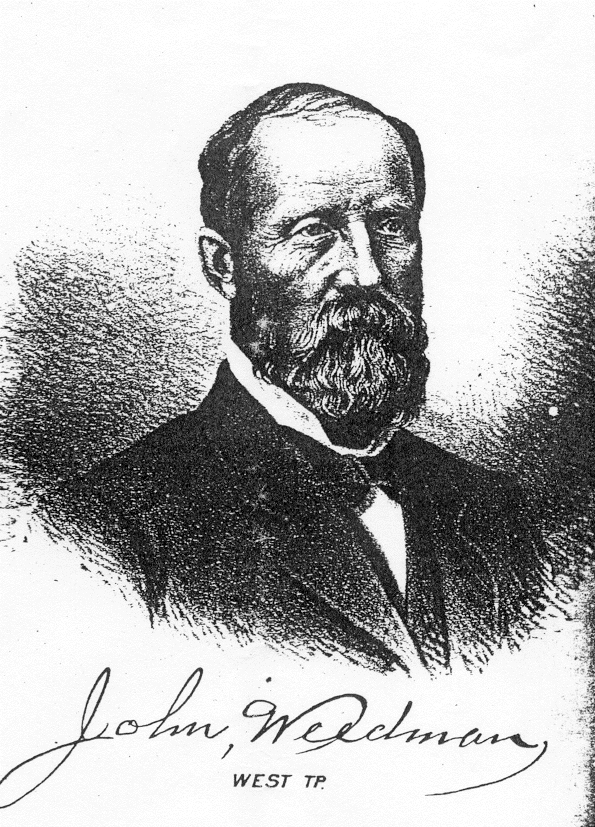
John Huhn Weedman, Jr. Obituary
Death of John Weedman
August 7, 1885. The funeral of John WEEDMAN, whose death has already been announced in THE PUBLIC, took place from his residence in West Township, McLean County, on Sunday, August 2, at 10 A.M. Rev. W. S. HOOPER and Rev. James SHAW conducted religious service. The attendance was very large and the solemnity of the occasion, in the presence of the grim messenger and his distinguished victim, inspired Mr. Hooper to put forth the best effort of his life in a funeral discourse. The text used was Proverbs xiii, 22: "A good Man leaveth an inheritance to his children's children; and the wealth of the sinner is laid up for the just." Mr. Shaw pronounced a eulogy on Mr. Weedman that extolled him to the skies, and certainly exhausted all the terms of praise, which properly pertain to the sphere of mortal life, if he did not encroach on the attributes of Divinity. The funeral ceremonies were in charge of the Masonic fraternity, and the members of the order left the Weedman mansion in advance of the procession, forming in line of march on foot and conducted the procession from where it entered town through the streets to the M. E. Church. The cortege was headed in the march through the city by the Farmer City cornet band, which moved slowly and solemnly to the music of a dead march and the sound of the muffled drum, while the church bell was tolling. At the church the Masons were seated in their carriages and the procession moved to the Campground Cemetery, two miles south-west of town, where sleep the father, mother, two brothers and other relatives of the deceased. At the grave the solemn and impressive ceremonies of the order were performed, and our honored brother was consigned to rest, while the richly ornamented and beautiful casket was covered with sprigs of evergreen, the emblem that perpetuates his good name and virtues in the hearts of his sorrowing Masonic brothers. While the procession moved from the church there were one hundred and fifty carriages in line, making it over a mile in length. Mr. Weedman's fine buggy horse was draped in mourning and followed next to the hearse in the procession. To say that this community is in mourning over the death of John Weedman is but a tame expression of the loss which is felt by his family, his relatives and the people with whom he has mingled and associated from the days of his boyhood up, and where the older he grew the more he was loved and honored. The sorrow of the family and nearer relatives is too deep and poignant to be soothed by any words of sympathy or power save that which "doeth all things well." When a man like John Weedman is stricken down in the strength and prime of his years the whole community feels the shock. Society in its commercial and social relations with the church and all humane and benevolent enterprises, must suffer in all their varied interests from the untimely, and to us erring mortals, mysterious dispensation. Our mortal scope is circumscribed within limits too feeble and finite to ever comprehend the reason why a man like John Weedman, the favored son of fortune, diffusing light and good to the world wherever he moved, should suddenly have his career of usefulness cut off, and the world deprived of such a benefactor. If we attempt to lift the veil and scrutinize the mystery we find no solution within the range of mortal ken, and must rest the case with the all wise and merciful Father who for some purpose to us unknown has called Mr. Weedman from our midst. Mr. Weedman was a favorite among his brothers and sisters and relatives, all of whom deferred to his opinions and advice on important business matters. The favoritism felt by the relatives of Mr. Weedman largely pervade the entire community, for it is to his public spirit and enterprise that Farmer City is mostly indebted for its standing and commercial importance. Prosperous in all his private enterprises, wealth flowed into his hands through legitimate channels and without any indirection or overreaching of his neighbors. While abundance crowned his efforts, dying a rich banker, his wealth did not, as it often does its possessors, make him a purse proud nabob, or dry up the fountains of his sympathetic nature. In the midst of his own prosperity he delighted to witness the prosperity of his neighbors, using his money as a blessing to mankind and not hoarding it with the selfish grip of the miser. The Weedmans and their large family connections including the McCORDS, the WAKEFIELDS, the CUMMINGS, the WILSONS and the RUTLEDGES form an important part in the early history of DeWitt and McLean counties. John Weedman's mother was a Wilson, and he was first cousin to James Wilson the late lamented treasurer of DeWitt County, whom he resembled more than he did his own brothers. Christy Weedman, a sister of John Weedman's father, married Robert Rutledge in 1822, it being the first marriage ever solemnized between white people in McLean County. John Weedman's father was among the early settlers of Hurly's Grove, and after living there for many years, moved to Iowa, where he died and his sons brought his remains back here for interment, and he rests by his first wife in the Campground Cemetery. Isaiah Weedman, brother of the deceased, fell at the battle of Holly Springs, and his brothers brought his remains home and he sleeps in the Campground Cemetery. John Weedman was the fourth son of John WEEDMAN and Rachael WILSON, and was born in Perry County, Ohio, Feb. 2, 1828. In 1830 his father moved to McLean County, Ill., and settled near Heyworth, and from there he moved to Hurly's Grove in 1836 and improved the farm on which his son George now resides. The subject of this sketch was eight years old when his father moved to this settlement, then a part of McLean County. There were seven stalwart sons of the Weedman family, five of whom sought fortune in the land of golden dreams and went to California in the year 1850. These were Asa, George, Amos, John and Isaiah. The Weedmans were among the early pioneers of this settlement, and the older boys and the father were famous deer hunters, as that game was roaming in great abundance over these prairies and among the brakes of Salt Creek when the Weedmans settled here. Mr. John Weedman was married to Miss Mary A. McDONALD, daughter of Thomas McDONALD, of Mt. Pleasant, now Farmer City, in 1853. The marriage was blessed with four children, two girls and two boys, all of whom and the mother survive the father and husband. The oldest daughter, Miss Josie, a young lady of great accomplishments, was married some five years ago to a Mr. Brodix. At an early day Mr. Weedman secured a tract of land amounting to 950 acres, about half of which was in McLean county and the other half in DeWitt county. The improvement of this magnificent farm on which stands a palatial residence, surrounded with all the beauties of ornament and luxury, has been the life work of its proprietor. On this handsome estate, over whose broad and green pastures herds roamed and ruminated, John Weedman lived and died. About the time the railroads were being built and Mt. Pleasant took the name of Farmer City, John Weedman and his brother-in-law, Wm. Y. McCORD, bought the R. O. Crawford farm of 100 acres and laid it out in town lots. These two gentlemen built a fine steam-flouring mill that afterward became the property of William HAYNIE and was burned down a few years since. About the same time John Weedman with Thomas brothers, George and Oscar, established a private bank in Farmer City. The bank continued under the firm name of Thomas Brothers & Weedman till 1876, when the Thomas Brothers withdrew, since which time it has been in the hands of Mr. Weedman, with J. B. LEWIS as cashier. John Weedman leaves a wealthy estate. Besides his fine farm and bank interest, he owns 50 acres of land in the corporate limits of the city, the Commercial House and a large number of vacant lots and other pieces of real estate in and around this city. Asa Weedman, the oldest of the seven brothers, died at his home near Farmer City nearly twenty years ago, and his remains rest in the Campground Cemetery, so that it seems to be an inherent principle in the Weedman family to cling together in death as they do in life. Four of the seven brothers still survive, Amos, late sheriff of DeWitt County, George, Z. C., and T. S., all well-to-do businessmen, the latter being the present mayor of this city. There are two sisters who also survive him, the late Mrs. W. Y. McCord, now Mrs. J. C. Rucker, and Mrs. Williams, widow of the late John Williams, of this city. For the grave, Mr. Weedman was dressed in a suit of very fine black cloth, with many floral offerings, handsomely wrought in wreaths and bouquets in and on the casket. The casket was very fine and costly, being of rare wood with massive silver mountings, beautifully and richly carved. We have indulged in no laudations or panegyrics because Mr. Weedman was a man of wealth, nor would we say he was without his foibles for he was human and possessed human nature, and that abiding sense of his own frailty which is the common heritage of all the descendants of Adam filled him with sympathy and good feeling for his race. In conclusion, we say that John Weedman was an upright man before his God, his country and his fellowmen. A model man in the church and all his business relations. In the purer and holier domestic relations of life was where the true man in its noblest phase was shown in the character of John Weedman. Honored friend and brother, we must say adieu, hoping that when life's fleeting hours have passed, we shall all be welcomed with the friendly grip to that lodge above where the solemn notes of the funeral dirge or the tolling bell shall no longer disturb us. Mr. Weedman was nearly 58 years old.
This page was last updated on February 22, 2009.